Cyber Resilience
What Does It Actually Take to Recover From Ransomware?
Most of the attention goes to preventing the attack. I've been studying the other half of the problem: the morning after, when the backups exist but the business still doesn't work.
Daniel Dayto
Enterprise Account Development at Rubrik · formerly Co-Founder & Technical Lead at Playmaker
- Published
- Reading time
- 12 min read
On This Page
The question nobody budgets for
On This Page
The question nobody budgets for
Almost everything written about ransomware is about preventing it. Patch faster, phish-proof your people, segment the network. All of that matters. Since moving into this industry, though, I've been studying the other side of the incident: suppose the attack already worked. It's Saturday morning, a few hundred servers are encrypted, and the business is down. What happens next?
I should say up front what I am and am not drawing on here. I spent seven years building and operating production systems, so I know what it takes to bring complex software back from ordinary failure. I have never sat in a ransomware war room. What follows comes from studying the public record — NIST's recovery guidance, CISA's #StopRansomware guide, and the detailed accounts that companies like Maersk and UnitedHealth have put on the record — read with an engineer's eye for where the hard parts hide.
The question nobody budgets for
Ransomware is now the most common pattern in serious breaches. Verizon's 2025 Data Breach Investigations Report found it present in 44% of the breaches they analyzed, up from 32% the year before. So a reasonable executive question is no longer "will this happen to someone like us?" but "if it happened Tuesday, how long until we're a functioning business again?"
Most organizations can answer the first question with a slide. Very few, as far as I can tell, can answer the second with a number they'd bet on. The gap between those two answers is what this piece is about.
What ransomware actually breaks
The mental model most people carry is encryption: your files get locked, you restore them, life resumes. Reading incident reports breaks that model quickly, for three reasons.
First, modern operators go after the recovery path itself. CISA's guidance is blunt about this: attackers routinely locate and encrypt or delete accessible backups before triggering anything visible, which is why the guide insists on backups that are offline, immutable, or otherwise out of reach of the credentials the attacker now holds. A backup the attacker could touch is better thought of as a hope than a plan.
Second, by the time ransomware detonates, the attacker has usually been inside for a while. In the Change Healthcare attack, UnitedHealth's CEO testified to Congress that the attackers got in on February 12, 2024, using stolen credentials on a remote-access portal that didn't have multifactor authentication, and deployed ransomware nine days later. Nine days is a long time to create accounts, plant persistence, and learn where everything lives. Which means after the attack, you can't simply trust the environment you're restoring into. "Restore" quietly becomes "rebuild on ground you've re-verified."
Third, the blast radius includes the tools you'd use to respond. Directory services, email, chat, monitoring, the password vault, sometimes the phone system. Several incident accounts describe response teams coordinating over personal phones and WhatsApp because nothing corporate worked. The systems you'd use to fix the systems are themselves down. As an engineer, this is the detail that rearranged my thinking; every operational runbook I ever wrote assumed the tooling around the broken thing still worked.
Backups are a copy. Recovery is a capability.
Two terms from NIST's contingency-planning guidance do a lot of work here. The recovery time objective, RTO, is how long the business can tolerate a system being down. The recovery point objective, RPO, is how much recent data the business can tolerate losing. They sound like compliance vocabulary, but they're really two sharp questions: how fast, and how fresh?
What I find useful about RTO and RPO is that they're properties of the business, set by the business, and then either met or not met by the engineering. A nightly backup means an RPO of up to 24 hours. For a law firm's document archive, losing a day might be survivable. For a payment processor, losing a day of transactions means money moved in the real world while the records saying so disappeared, which is a reconciliation crisis more than a storage problem.
The trap is that a backup program can be healthy while the recovery capability is fiction. Restoring one database is a storage problem. Restoring a business is a systems problem: in what order do two hundred interdependent services come back, what does each one need running before it will even boot, who re-issues the credentials, and how do you confirm each restored host is clean before you connect it to the next? None of that is on the backup success dashboard. I went deeper on the systems half of this in a companion piece.
Identity comes back first, which is the problem
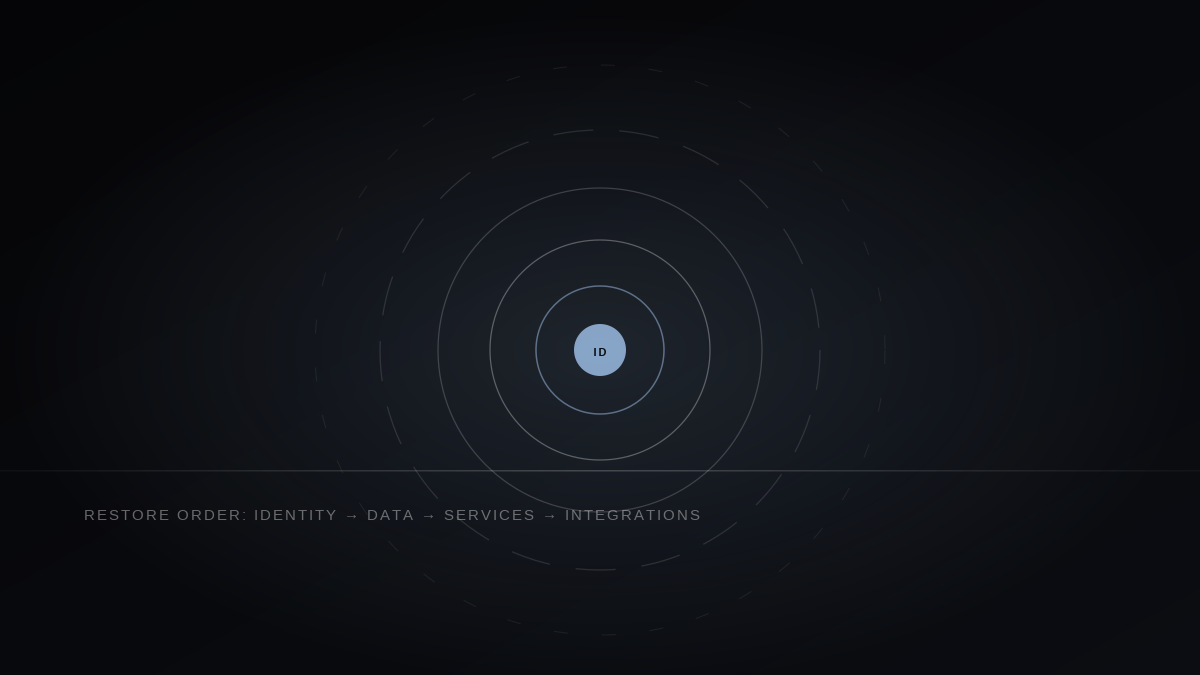
Here's a dependency most people outside infrastructure never think about: nearly everything in a modern environment authenticates against a central identity system, usually Active Directory or a cloud identity provider. Applications, service accounts, admin consoles, the backup platform itself. If identity is down or untrusted, restoring anything else mostly produces servers you can't log into.
The canonical story is Maersk. When NotPetya tore through the company in 2017, it destroyed, by the chairman's own account, roughly 4,000 servers and 45,000 PCs. Every replica of Active Directory went down with the ship, except one: a domain controller in Ghana that happened to be offline during the attack because of a local power cut, a detail reported in WIRED's account of the incident. A significant fraction of a global shipping company's recovery hinged on retrieving that one machine's data. The rebuild took about ten days of around-the-clock work.
I keep thinking about the Ghana domain controller because of what it says about unexamined assumptions. In seven years of building systems, I treated identity the way I treated DNS: ambient, boring, somebody else's uptime problem. Every architecture diagram I drew had an arrow to "auth" that I never once imagined having to rebuild from nothing. Attackers, apparently, read those diagrams more carefully than I did.
A small, uncomfortable walkthrough
To make this concrete, here's an illustrative composite, not a real client or a real incident. Picture a mid-sized field-service company, the kind of business I built software for at Playmaker: a few hundred technicians, a scheduling system, a customer database, phones, invoicing, payroll.
Ransomware hits overnight. The backups worked; the data exists. Now watch what the restore doesn't cover. The scheduling database comes back, but the application servers that talk to it were rebuilt from images, and their service credentials were rotated during the response, so nothing connects until someone re-wires secrets by hand. The phone system is cloud-hosted and fine, but it forwards calls based on an on-premises routing service that is not fine. The payment processor flagged the company's API traffic going dark and suspended the integration; re-enabling it requires a support ticket and a verification call. Payroll runs Friday. Jobs booked in the four hours before the attack exist on customers' calendars but not in the restored database, and nobody knows which ones.
Every individual problem on that list is small. That's what makes the list instructive: recovery time is dominated not by the headline restore but by dozens of unglamorous reconnections, each owned by a different person, some owned by vendors, none of them written down anywhere because they were configured once, years ago, and forgotten. This matches my experience of ordinary outages as an engineer. The database restore was never the slow part. The slow part was everything the database quietly held together.
Recovery is rehearsed, not written
NIST's Guide for Cybersecurity Event Recovery and its updated incident-response guidance both land hard on the same point: a recovery plan that hasn't been exercised is a hypothesis. Testing is what converts it into a capability, and testing at realistic scale is where organizations discover their actual RTO, which is routinely a multiple of the documented one.
This is the part of the field that felt immediately familiar. At Playmaker, I learned the hard way that changes which passed review could still break production in ways only a regression suite run against real scenarios would catch, so we made the rehearsal the gate. The same logic applies here with higher stakes. A restore you have never performed is a restore you don't have; you merely have storage costs. The teams that recover quickly in the public accounts are the ones that had practiced recovering, which sounds circular right up until you've watched an unpracticed team meet a surprise.
The decisions are the hard part
The technical sequencing is at least knowable. What the incident accounts convey most vividly is the decision load, made under pressure, with partial information, by people who haven't slept. Do you disconnect systems that are still running, trading certain disruption now against possible spread? When is the environment clean enough to start restoring into? Do you pay?
Change Healthcare paid a $22 million ransom. It did not buy back the business. UnitedHealth reported roughly $2.5 billion in incident-related impacts through the first nine months of 2024, advanced nearly $9 billion in assistance to healthcare providers whose cash flow had stopped because claims couldn't move, and spent months restoring services. Whatever the ransom decision bought, the recovery still had to be engineered and executed, system by system, while a meaningful slice of the US healthcare payments infrastructure waited.
That ratio, twenty-two million against two and a half billion, is the clearest evidence I've found for a conclusion that took me a while to accept: the ransom is rarely the expensive part. The expensive part is time. Which reframes the whole topic, because time-to-recover is exactly the variable that preparation, architecture, and rehearsal can actually move.
Questions worth asking
If I were stress-testing my own readiness
- Could our backups survive our own admin credentials being used against them? Offline or immutable copies are the test, per CISA.
- How long would it take to restore identity alone, from nothing, and has anyone ever tried?
- In what order would our services come back, and is that order written down anywhere outside one engineer's head?
- When did we last rehearse a full restore of a revenue-critical service, and what was the measured time?
- Which third parties would need to re-verify us before reconnecting, and how long do their processes take?
- Who makes the disconnect, restore, and payment decisions at 3 a.m., and do they know it?
I don't have operational answers to these yet; I'm early in this field and I'd rather be honest about that than perform certainty. But I've noticed that the engineers and security leaders I ask these questions don't find them naive. They find them uncomfortable, which in my experience is what the right questions feel like.
Sources
Sources & further reading
- NIST SP 800-184, Guide for Cybersecurity Event Recovery
- NIST SP 800-34 Rev. 1, Contingency Planning Guide for Federal Information Systems
- NIST SP 800-61 Rev. 3, Incident Response Recommendations and Considerations (April 2025)
- CISA, #StopRansomware Guide
- Verizon, 2025 Data Breach Investigations Report
- House Energy & Commerce Committee, What We Learned: Change Healthcare Cyber Attack (May 2024)
- HIPAA Journal, Change Healthcare incident cost tracking from UnitedHealth Group earnings reports
- WIRED, The Untold Story of NotPetya
- BleepingComputer, Maersk chair's Davos remarks on the NotPetya rebuild
About the author
Daniel Dayto
Enterprise Account Development at Rubrik · formerly Co-Founder & Technical Lead at Playmaker
Daniel Dayto works in enterprise account development at Rubrik, focused on cybersecurity and cyber resilience. Before that, he spent seven years in software engineering and technical leadership — most recently as co-founder and technical lead at Playmaker, building production voice AI for service businesses.
Related articles
Technology & Business Strategy · November 22, 2026
The Real Cost of Downtime
Published downtime averages hide more than they reveal. A practical way to reason about what an outage would cost your business: which revenue dies versus defers, what idles, what triggers, and why the meter doesn't stop when the systems come back.
Engineering Perspectives · November 22, 2026
Why Enterprise Systems Are So Difficult to Recover
A backup captures a component. A business runs on a graph: identity, shared databases, queues, secrets, third-party integrations, and configuration nobody wrote down. An engineer's tour of why whole-system recovery is so much harder than its parts.
Thoughts on this one?
I'm always interested in thoughtful conversations about cybersecurity, technology, and the challenges businesses face. If this sparked something — agreement, disagreement, a war story — I'd like to hear it.