Engineering Perspectives
Why Enterprise Systems Are So Difficult to Recover
Restoring a server is a solved problem. Restoring two hundred interdependent services, in the right order, with consistent data and working credentials, is not. Seven years of building these systems explains why.
Daniel Dayto
Enterprise Account Development at Rubrik · formerly Co-Founder & Technical Lead at Playmaker
- Published
- Reading time
- 12 min read
On This Page
The laptop fallacy
On This Page
The laptop fallacy
When my laptop died a few years ago, recovery took an afternoon: new machine, restore from backup, sign back into things, done. That experience is most people's mental model of restoring from backup, and it's the model that quietly fails when scaled to an enterprise. I want to explain why, because I spent seven years building the kinds of systems that make it fail, and the reasons are concrete rather than mysterious.
A note on vantage point: I've never run disaster recovery for an enterprise during an attack. What I have done is design, ship, and operate production systems for airlines, retailers, and service businesses, which means I know in detail what those systems need around them just to boot. This essay reasons from that architecture, checked against the public recovery accounts and NIST's recovery guidance.
The laptop fallacy
The laptop restore works because a laptop is a self-contained unit: one device, one user, one coherent snapshot. Enterprise backup tooling extends that model to servers and databases, and at the component level it genuinely works. Where the model breaks is the assumption hiding inside it: that the thing you restored is the thing the business needs. The business never needed the server. It needed the service, and the service was never on one machine.
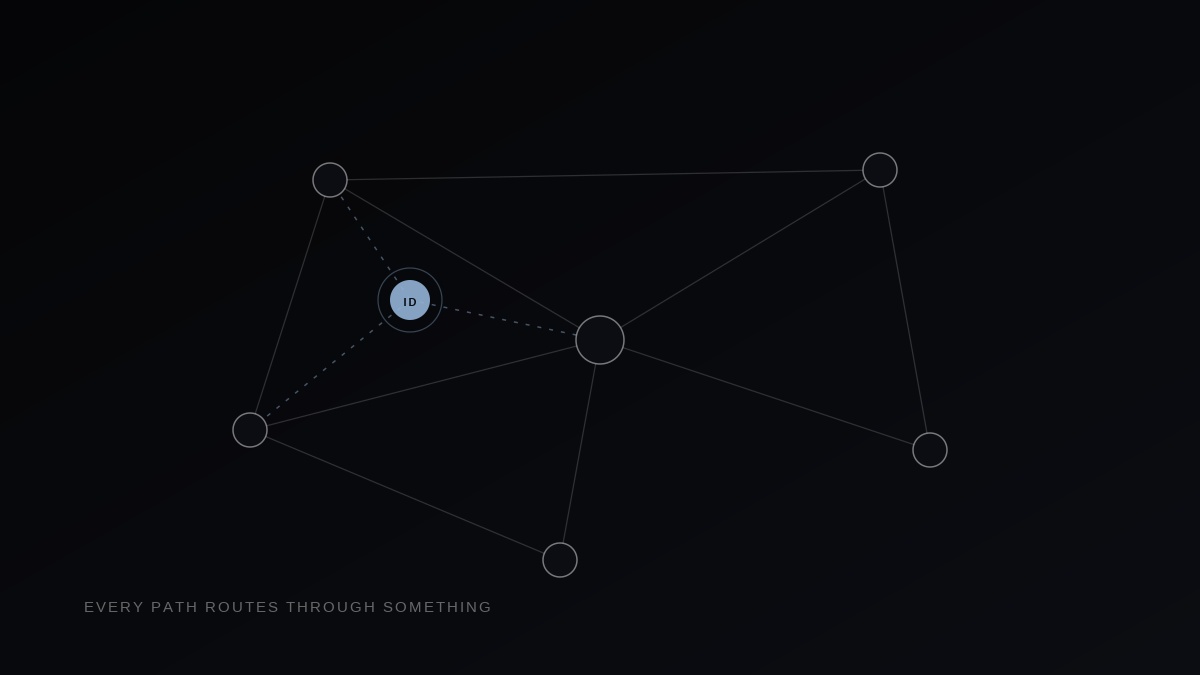
You don't run applications, you run a graph
Consider a booking flow like the ones I built for Emirates' loyalty platform. On an architecture diagram it's one arrow: search, book, pay. In production it was an identity provider for sign-on, several rail carriers' APIs, a booking orchestration service holding distributed state, a payment gateway handling card and loyalty-mile combinations, databases, caches, queues, DNS, certificates, and a monitoring stack watching all of it. That's one customer journey in one product.
Now multiply by every workflow in a company and you get the real topology: hundreds of services, many sharing databases and message queues, connected by calls that exist nowhere on any diagram because they were added in a sprint five years ago by someone who has since left. Restoring any single node from backup is easy. The question that determines recovery time is different: which nodes does this node assume are already up, and what does it do when they aren't? In my experience writing these services, the honest answer to the second part is usually "crash on startup," because we wrote retry logic for transient failures, never for a world where the dependency simply isn't there.
Identity: the dependency under the dependencies
One node deserves special attention because nearly every other node points at it. Humans authenticate through the directory or identity provider. Services authenticate with service accounts, tokens, and keys issued by that same infrastructure, fetched from secrets managers that themselves require authentication. Even the backup and virtualization consoles you'd use to perform the recovery typically sit behind corporate identity.
Attackers understand this topology well. MITRE catalogs the deliberate destruction of recovery capability as its own technique, Inhibit System Recovery, and the loudest real-world illustration remains Maersk in 2017, which, as WIRED documented, lost every live copy of Active Directory at once and rebuilt from a single domain controller that survived by being offline during a power cut. I wrote more about that incident in the recovery essay; the architectural point here is simpler. In every system I ever shipped, identity was an assumption, not a component. Nothing in my code knew how to exist before auth did. That assumption is exactly what a recovering organization has to live without, which is why identity restoration leads every serious recovery sequence.
Data consistency across systems
Backups capture systems one at a time, and each backup is a snapshot of one system at one moment. Restore the order database to 2:00 a.m. and the inventory database to 2:45 a.m., and you've created a world where products were sold that were never decremented, or decremented but never sold. Each database is internally perfect. The business state spanning them is corrupt.
I dealt with a small version of this constantly at Playmaker. Our voice agents persisted bookings locally first, then wrote them into the customer's CRM, with reconciliation for when the CRM write failed mid-flight. Even in normal operations, keeping two systems' views of "what jobs exist" in agreement took deliberate engineering: idempotent writes, replay, a source-of-truth rule for every field. Now imagine that reconciliation problem across an enterprise's ERP, CRM, billing, and warehouse systems simultaneously, after restoring each to a slightly different point in time, under pressure, with the people who understand the edge cases unavailable. The data is "back." Agreement between systems is a project that starts after the restore finishes.
Sequencing and the circular-dependency trap
Given a dependency graph, recovery order should be a topological sort: bring up the things with no dependencies, then the things that depend on them, outward to the applications. Reality complicates this twice. First, nobody has the actual graph; discovery happens during the incident, by bringing a service up and seeing what it complains about. Second, mature infrastructure accumulates cycles. Monitoring that would tell you what's healthy requires authentication; authentication logs to the monitoring stack. The virtualization console that hosts DNS needs DNS to resolve its own storage. These cycles are invisible in steady state because everything is already running. A cold start exposes them all at once.
At WOLF I had a gentler education in sequencing: a deployment pipeline for 50+ apps where builds, signing, and release steps had ordering constraints that existed mostly in my head until I encoded them into the pipeline. Encoding them was the work. I've come to read disaster-recovery runbooks the same way: the valuable ones are the ones where someone did the tedious job of writing the order down and then proved it by running it.
The system is more than its data
A database backup contains the data. It does not contain the firewall rules that let the application reach the database, the DNS records, the TLS certificates, the environment variables, the feature flags, the cron schedules, or the undocumented kernel setting an engineer applied during an outage in 2021. In infrastructure-as-code shops much of this lives in version control, which helps enormously, and in my experience the coverage is never complete; production accumulates drift the way kitchens accumulate junk drawers.
This is why "rebuild from scratch" and "restore from backup" are both euphemisms. Real recovery is archaeology: reconstructing the configuration layer that made the data usable, from whatever fragments of it were written down.
Third parties hold part of your state
Modern applications outsource aggressively: payments, telephony, email, maps, analytics, auth itself. Each integration carries state on the vendor's side that your backups don't touch: API keys, IP allowlists, webhook registrations, OAuth grants, fraud-model baselines. At Playmaker, a single voice agent leaned on a telephony provider, a scheduling system, and a CRM; the agent without its integrations was a well-architected answering machine.
After a security incident this gets harder in a specific way: the vendor's caution works against you. Keys get rotated during response, so every integration needs re-wiring. Vendors that saw your traffic die, or learned of your breach, may suspend access and require re-verification on their timeline, not yours. Your recovery now has external dependencies with their own queues. None of this appears in an RTO calculated from restore speeds.
Why only rehearsal tells the truth
Everything above shares a property: it's invisible until exercised. The undocumented dependency, the circular bootstrap, the drifted config, the vendor re-verification queue — each one is discovered precisely at the moment it blocks you, unless you've arranged to discover it earlier on purpose. That's the entire argument for recovery testing, and it's why NIST SP 800-184 and CISA's guidance keep returning to exercises rather than documents.
The engineering parallel that convinced me is regression testing. At Playmaker I learned that a change could pass review, look correct, and still quietly break an unrelated behavior; only a suite that replayed real scenarios caught it, so passing the suite became the condition for shipping. A disaster-recovery plan that has never been executed is the same artifact as an untested change: plausible, reviewed, and unverified. The restore you've rehearsed is the only one you actually possess.
The cold-start question
If I were responsible for an enterprise's resilience, the question I'd now ask of every critical service is what I've started calling the cold-start question: starting from storage and documentation alone, with no running infrastructure and no cached credentials, what is the ordered list of steps that brings this back, and when did we last execute it? The length and freshness of the honest answer tells you more about recovery readiness than any tooling inventory.
I find this problem genuinely interesting, in the way hard distributed-systems problems are interesting, with the added weight that the answer determines whether a company survives its worst week. If you've actually run a cold start, in anger or in an exercise, I would sincerely like to hear what surprised you. The gap between how I reason about this and how it played out for you is exactly what I'm trying to learn.
Sources
Sources & further reading
About the author
Daniel Dayto
Enterprise Account Development at Rubrik · formerly Co-Founder & Technical Lead at Playmaker
Daniel Dayto works in enterprise account development at Rubrik, focused on cybersecurity and cyber resilience. Before that, he spent seven years in software engineering and technical leadership — most recently as co-founder and technical lead at Playmaker, building production voice AI for service businesses.
Related articles
Cyber Resilience · November 22, 2026
What Does It Actually Take to Recover From Ransomware?
Backups are a copy of your data. Recovery is the ability to turn that copy back into a working business — identity systems, dependencies, decision-making and all. Notes from an engineer studying the gap between the two.
Technology & Business Strategy · November 22, 2026
The Real Cost of Downtime
Published downtime averages hide more than they reveal. A practical way to reason about what an outage would cost your business: which revenue dies versus defers, what idles, what triggers, and why the meter doesn't stop when the systems come back.
Thoughts on this one?
I'm always interested in thoughtful conversations about cybersecurity, technology, and the challenges businesses face. If this sparked something — agreement, disagreement, a war story — I'd like to hear it.